
MID MIX TechnologY
One reaction does the job:
Lime and water in the sludge.
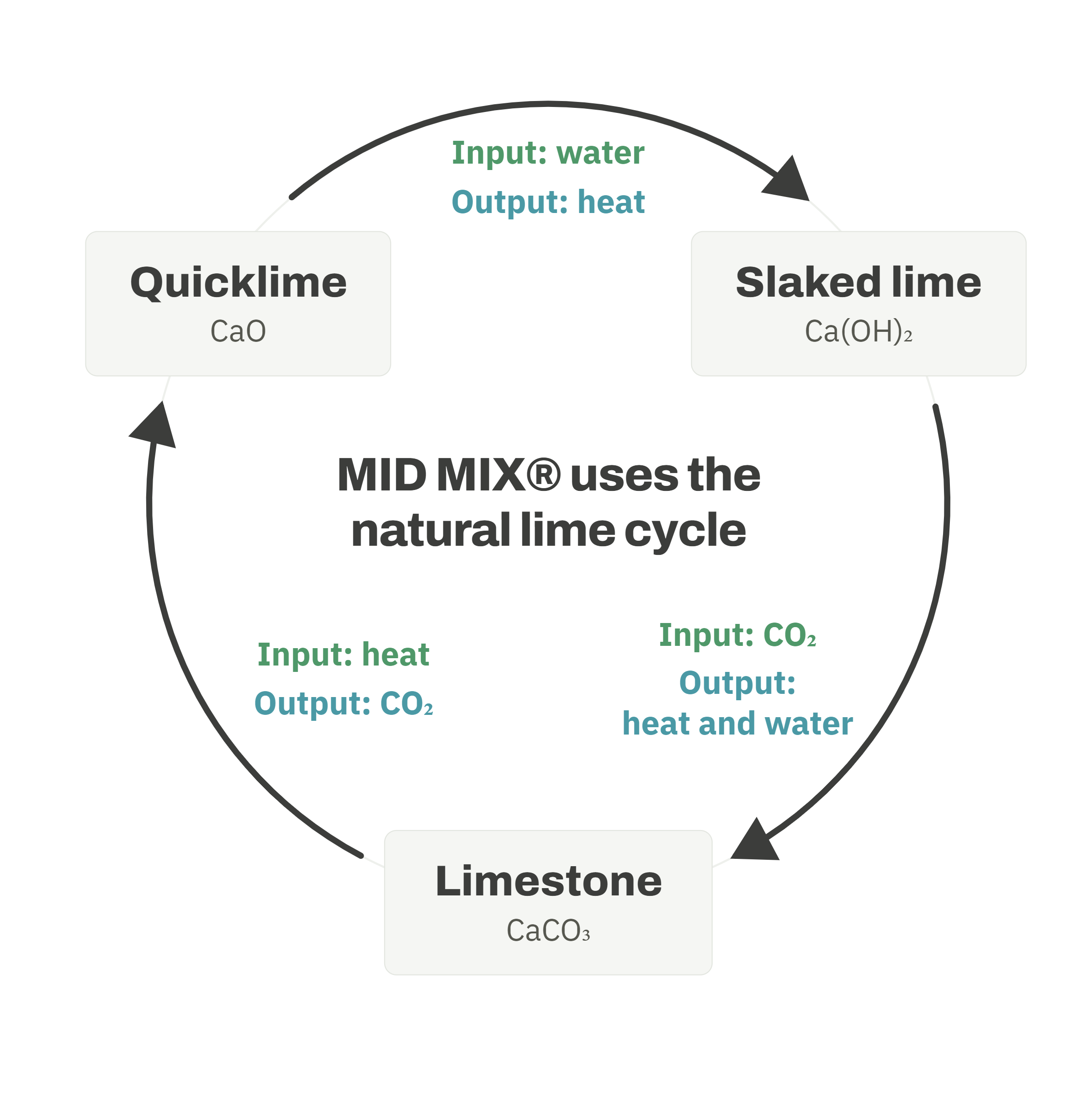
Sludge is an output of many processes, but never the primary goal. It still has to be treated or removed from the site every day, so the core business can keep running. MID MIX® uses the natural lime cycle to achieve that. The process can operate 24/7. The reactor only needs lime to run the process. For the rest, we use what’s already in the sludge.
Water as the driving force of the process
Sludge mostly consists of moisture. Incineration means boiling off all that moisture first: energy-intensive and expensive. MID MIX turns that around: the water drives the process.
In the reactor, we add quicklime (CaO) to the sludge. The lime reacts with the water to form calcium hydroxide; organic material and CO₂ from the air react further to form calcium carbonate. That reaction generates its own heat: around 90°C, with no external heating. The pH rises to 12.5 or higher. Bacteria and viruses don’t survive that combination.
This way we turn black, wet sludge into Neutral: a white, dry, validated product. In doing so, MID MIX follows the natural lime cycle and captures CO₂ from the air during the process, which makes the footprint negative.
Heavy metals
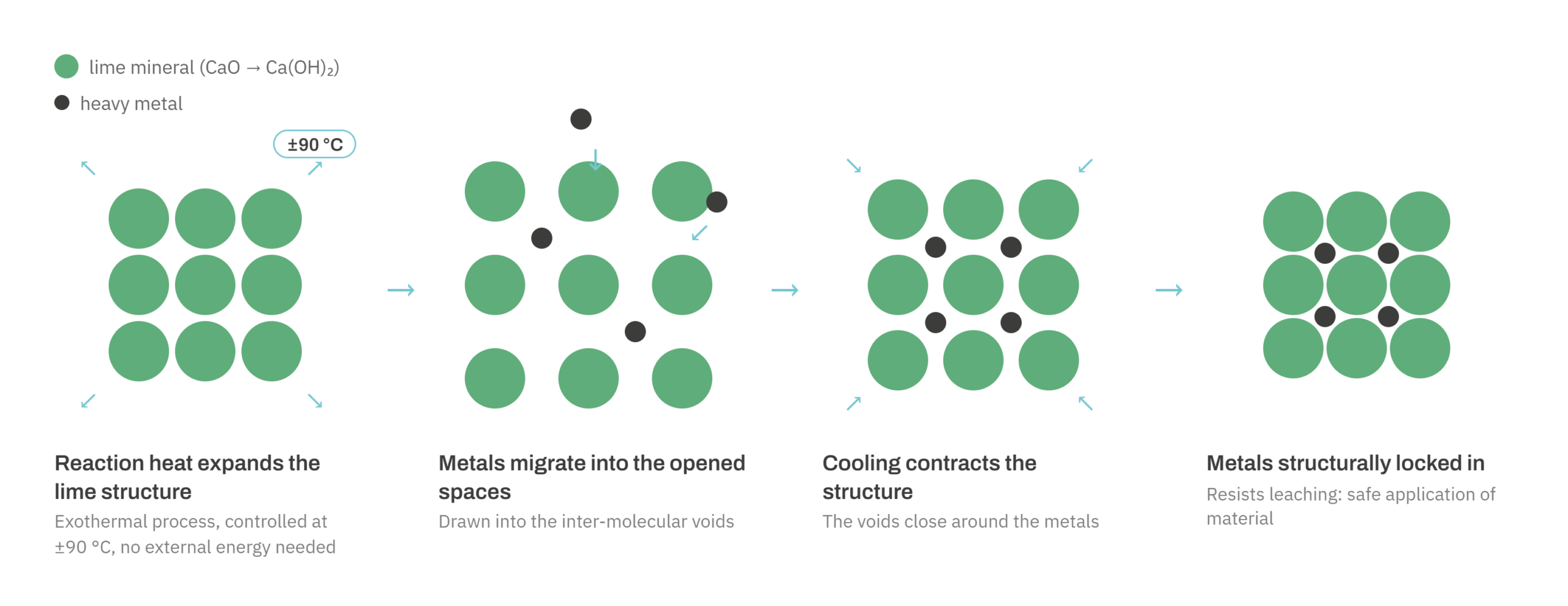
The heat expands the lime molecules, creating space between them. Heavy metals migrate into those spaces. As it cools, the structure contracts and the metals end up structurally locked inside the mineral. The result is strongly reduced leaching of heavy metals when applying Neutral.
Mineral oils, PAHs, PCBs, PFAS and pharmaceutical residues typically end up 5–10× lower in Neutral than in the incoming sludge, measured per stream. Was there ammonia in the sludge? More than 98% of it is captured via a multi-stage scrubber and converted into ammonium sulphate, a raw material for the fertiliser industry.
Encapsulation
Heavy metals are encapsulated, which reduces leaching.
SpecificatiONS
The MID MIX process, in numbers.
| Input | Almost any sludge or sludge-like stream at 18–70% dry solids. |
| Capacity | 8 tonnes/hour per line; up to 60,000 tonnes/year at 24/7 operation, ~25,000 tonnes/year at 12 hours/day, 6 days/week. |
| Expandable | Additional lines can be installed side by side. |
| Footprint | Ideally ~1,500–2,000 m² of process floor, 12 m of clear height (storage and logistics outside that, depending on your situation). A smaller footprint is sometimes possible: if the building layout allows it and there’s room outside, we’ll look at whether the core process can fit a smaller area. |
| Existing infrastructure | At the plant design, we use existing infrastructure as much as possible. |
| Experience with many streams | Organic and inorganic industrial sludge, sewage sludge, digestate, soil-cleaning residue, screening sand; 30+ streams processed at the pilot installation |
Too wet for this range? A dewatering step before MID MIX brings many streams within reach.
Too dry? We can add water in the reactor.
Where we stand now: the pilot installation (4 tonnes/hour) has processed over 30 streams; the design improvements from that work are built into the full-scale design. The first full-scale line is now in development.
COMPARISON WITH MONO INCINERATION
No incineration. That makes a real difference.
In the Netherlands, MID MIX can meet the minimum standard under the Circular Materials Plan (CMP) for many streams, for example sewage sludge, screening sand, soil, dredged material and residues. Assessment against the CMP is done case by case and also depends on the exact composition of the waste stream. Equivalent circular-economy frameworks apply across the EU.
Curious what MID MIX could mean for your situation?
With a scan based on your own figures, we’ll show whether MID MIX fits your situation, no obligations.
And if MID MIX doesn’t fit, we’ll think along on what does.

A circular solution for sludge treatment with a strong business case.
Contact
Certification
SGS Intron
NEN-EN 12.620
NEN-EN 13.043
© 2026 VSGM B.V. · MID MIX® · Neutral